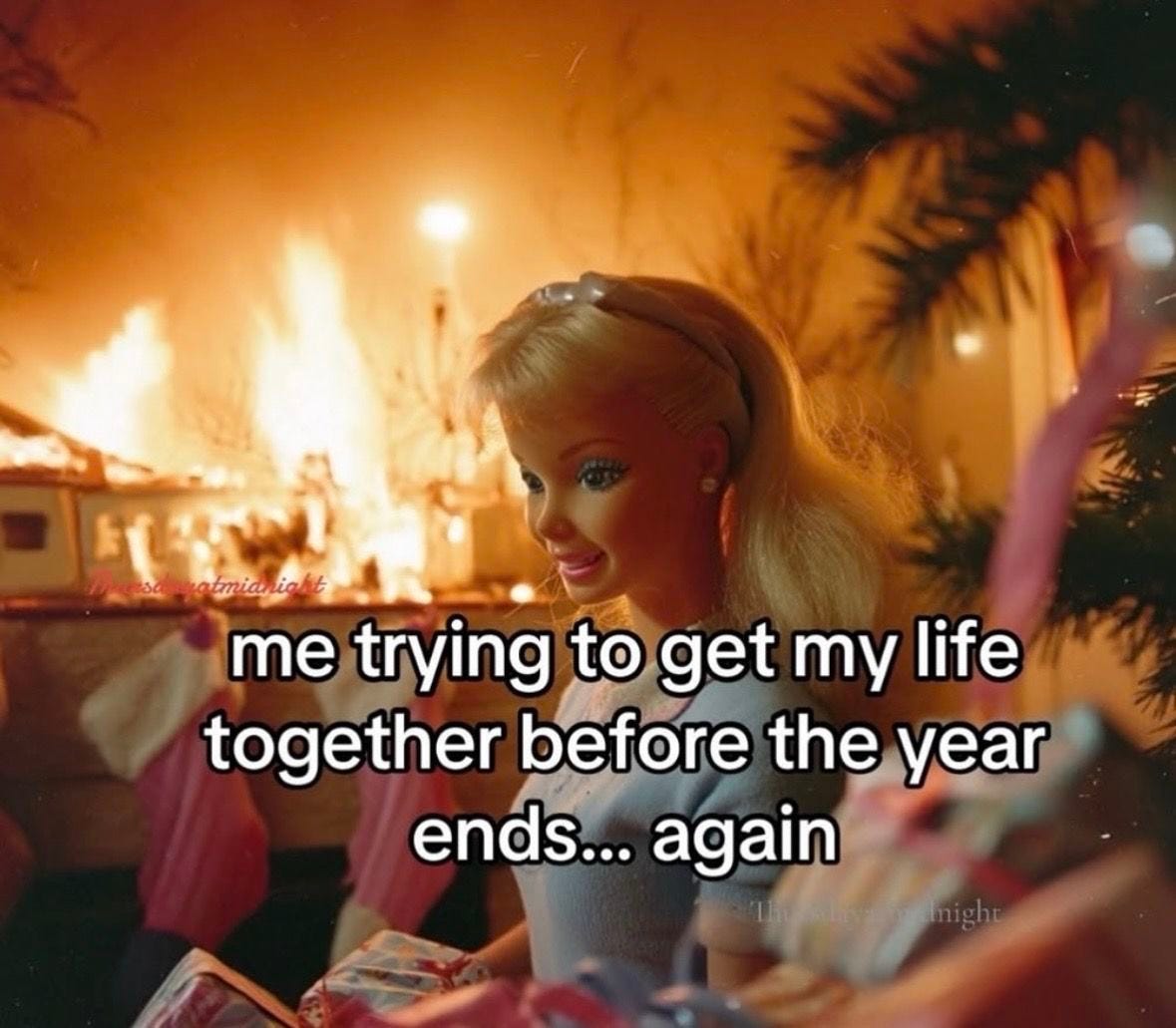
Closure Doesn’t Do NYE Countdowns (part 1/2)
Why Hollywood, self-help books, and your brain are all lying to you about healing.

Let’s get real about the flaws, frustrations and fallibilities of ‘closure’ before this year ends and a new year begins, folks.
There is so much to think and feel when it comes to ‘closure’, what closure actually means, the societal pressure to ‘be fixed’ by 31 December and to start the new year with a metaphorically pristine, clean slate.
I’ve had strong thoughts and feels about this for years. To save the deep scroll and risk of developing RSI, I have written two parts. This is part one. Part two lands on 1 January 2026 — just in time for the new year’s contemplation and commercialisation to swirl.
The soundtrack for part one is ‘Liability’ by Lorde — a song with raw honesty about the narratives we tell ourselves, and how we feel we are failing at the emotional work everyone else seems to have mastered. No whimsy. No inspo. Just real talk. Hit play and let’s dive in.
Surely we’ve all done this, right?
We’ve naively given ourselves a literal deadline to achieve a sense of ‘closure’ -whatever that means - by 11.59pm on 31 December. And why not? We’re organised and pragmatic in our daily lives. We roll from one planned thing to another, just like society expects of us. So this approach translates perfectly into how we enter the new year, right? It’s in our calendar, so obviously we’re going into the new year fully liberated from a fundamentally life-altering experience that’s had a profound impact on us during the year, even though it requires serious mental, emotional and physical healing.
Duh. Nah. Just ask Sad Kendall Roy.
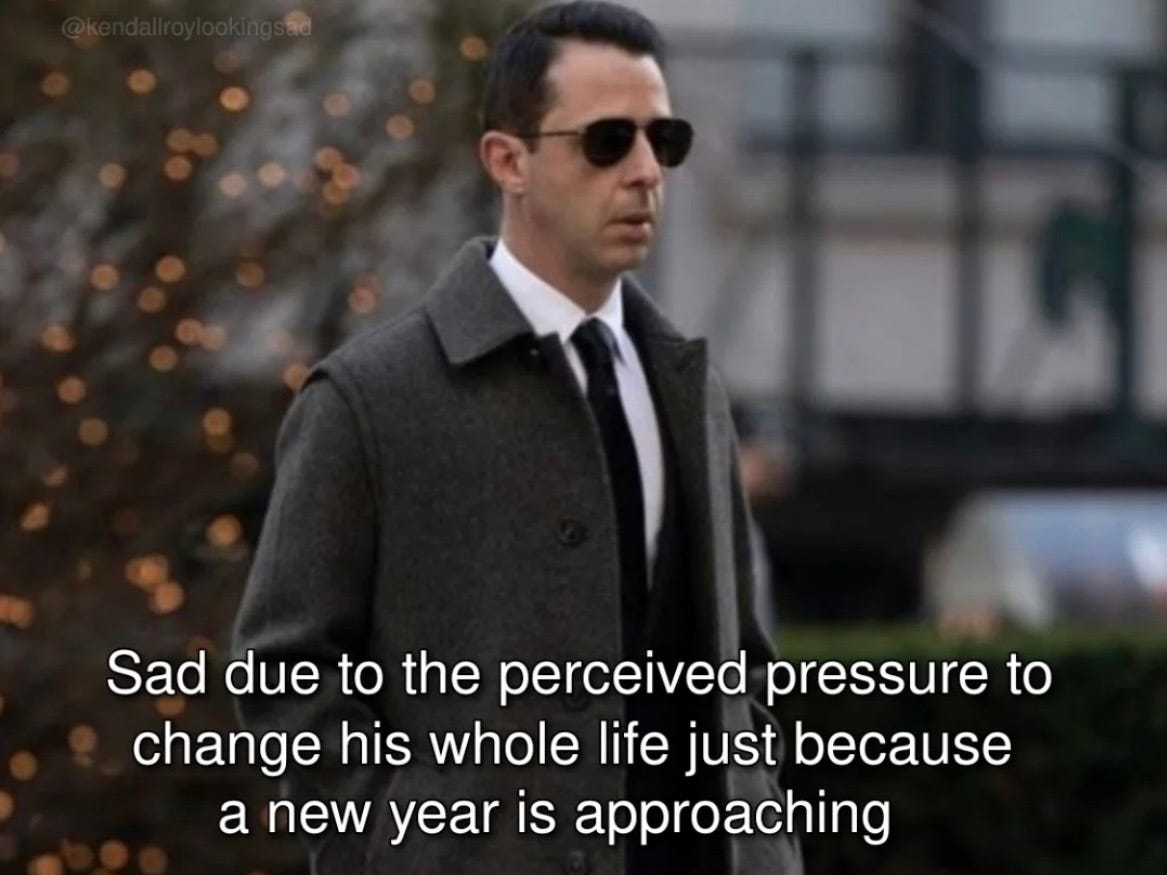
December comes and suddenly everything becomes urgent.
We start tallying everything up. A tally that begins with the year’s wins and failures, lessons and learnings, before descending into a vortex of all that remains unresolved. The unfinished conversations. The relationships that fizzled without explanation. The good and bad surprises. The fights that never recovered. The mental health struggles. The hurt that’s still holding onto your heart for dear life. The grief of something you will never know or have again.
Then the pressure to close everything out by 11.59pm on 31 December hits. And it hits hard. Of course we are expected to ‘get closure’ neatly on schedule. So we add it to our daily planner of to-dos, right next to:
Get petrol
Pick up click and collect
Restock oat milk
Get ‘closure’
As if closure is something to tick off our to-do list. As if healing has an expiry date. As if we can schedule emotional processing to commence in the second week of December, participate in a few 101 meetings with ourselves, close out the action list, and file it as ‘complete’ by deadline.
It’s a bitter pill to swallow. Deep down, we know closure doesn’t work like that, right? It never has. The more we pretend it does, the more we try to force it into delusional, arbitrary timelines and structurally flawed resolutions. We set ourselves up for disappointment, frustration, and that stormy feeling that we’re failing at something really big. Something that should never be a test or ever have a hard deadline.

Film and TV lied to us. Deliberately.
We’ve been fed a very specific story about what closure looks like. It’s tidy. It’s definitive. It’s scored by Hans Zimmer or Charli XCX. It’s the conversation where everything gets said, the apology that lands perfectly, the moment of mutual understanding where both parties nod and walk away lighter. Roll credits. Fade to black. Everyone’s healed and ready to move on.
Hollywood loves this version.
We’ve got The Notebook.
Allie shows up in the rain and they have that massive screaming match that somehow resolves decades of unfinished business in about four minutes? Sorted. Closure achieved. Cue the make-out session. Never mind that in real life, showing up at someone’s house in a thunderstorm to yell at them is called ‘unhinged behaviour’ and usually ends with the neighbours calling the police.
Take the beloved Fleabag.
The entire show is a masterclass in messy humanity. Sadly, even this show gives us the Hot Priest goodbye —painful, perfect, and yet, all wrapped up in one devastating scene. ‘It’ll pass,’ he says, and we’re meant to believe that’s it. She’s free now. Healed. Moving on. Except we all know she probably cried in the shower for three weeks afterwards and stalked his Instagram. Because my god, I would, too.
But ‘it’ll pass’ was never in the original script. Did you know that? The dialogue between Hot Priest and Fleabag was to end with Fleabag saying ‘I love you’ to Hot Priest, and Hot Priest saying nothing in return before walking away.
What happened, then? Well, Andrew Scott, Hot Priest himself, shared with Phoebe Waller-Bridge his strong belief that Hot Priest simply wouldn’t walk away without saying anything to her in reply. And so, ‘it’ll pass’ came to be — fundamentally changing the narrative by telling us all that yes, Hot Priest chose God over Fleabag and as they part ways, they’ll go on their own respective healing journeys.

And let’s not forget about 500 Days of Summer.
The film tries to be self-aware, the whole point being that Tom’s version of closure is fantasy. Cue that exquisitely devastating ‘Expectations’ vs ‘Reality’ montage set to Regina Spektor’s ‘Hero’, which had 19-year-old-me in a chokehold for several years (and reinforced my scepticism about love). Yet, they still give us that meet-cute with Autumn at the end, suggesting that closure is just… meeting someone new? That the way you stop hurting about one person is by finding another? Tom’s look to the camera at the end implies that another season of love is on the way. Lies. I see it as a ‘gotcha, sucker’, in a meta way.
Even Eternal Sunshine of the Spotless Mind does it.
This is a film literally about people erasing their memories because closure is impossible. Still, it ends with that beach scene. That understanding. That sense of ‘oh okay, we tried, we failed, but now we know.’ It’s devastating and beautiful. It’s also contained. It’s a film. It can end after 90-plus minutes. It gets to fade to black while Clementine’s hair is still the perfect shade of blue, with no fading or regrowth, and nothing has had time to get complicated again.
Why do they do this to us?! Our lives don’t fade to black. Life keeps going and has to keep going, even on a random Tuesday when the Spotify algorithm serves you one of those song, and next minute you’re crying on the toilet wondering if this counts towards healing and ‘moving on’.
The day the music lied.
There’s the breakup album where the singer goes from devastation to empowerment in 12 tracks, and if we’re lucky, a bonus track for us to blubber to. Taylor Swift has built her empire on this. Every relationship is composed from meeting to ending, grief to acceptance, victim to victor. It’s cathartic to listen to. It’s both literature and art. It rallies Swifties wonderfully. It’s also a narrative. A story with a curated beginning, middle, and end. Actual closure just isn’t cinematic or sparkly enough for the mainstream, so we get gaslit into believing our healing process is flawed, boring, slow, enraging, exhausting, repetitive and wrong — just because it isn’t accompanied by its own Jack Antonoff-produced soundtrack.

The self-help industrial complex will take your money now.
Social media has turned closure into performance art. We all know it, one way or another. And we’re both the artists and the audience, watching each other pretend that we’ve got it sorted. We’re told we can get our lives sorted simply by reading some articles, like:
Ten steps to get closure after a break-up
How I finally let go of my toxic ex (and you can too)
The secret ritual that changed everything for me (get the template via link in bio)
This journal saved my life, and it can save yours too for just $59.95
It’s all very actionable. Very aesthetic. Very bullshit.
Then there’s the books. Oh god, the books.
Now — before I go on, I openly and somewhat guiltily admit that in the past I have really enjoyed and appreciated some of these so-called ‘self-help’ books that we’ve been served. You might have, too. But right now? No. Having made it through the emotional whiplash of 2025, still feeling raw and rageful, I want to light every ‘self-help’ book I see on fire and watch it burn.
The epic capitalisation and commoditisation of self-help literature, the rise and rise of so-called ‘experts’, ‘gurus’, ‘specialists’, ‘voices’, ‘exponents’, all lacking legitimate credibility is criminal. Every airport bookstore has an entire wall dedicated to books promising you the path to closure, healing, transformation, and presumably eternal happiness if you just read chapter seven carefully enough. The caveat being you must reach this chapter by the time you arrive in Singapore for your layover.
They’ve got beautiful covers. Minimalist fonts. Endorsements from influential people. Headshots projecting equal parts smarts and very white, veneered teeth. They’ve sold millions of copies. They’re on every ‘must-read’ list. They’re quoted in Instagram captions over sunsets, oceans and latte art. With every new book release, we’re rallied to think ‘maybe this is the one, the one that’ll finally help me get through this.’
*Adds to cart.*
We buy it at 11pm on a Monday night after scrolling past another excerpt that made us stop mid-scroll and think ‘Ah, f*ck. This hits, and is exactly what I need to hear right now.’ We pay the outrageous $14.95 fee for express shipping because we need it right now. We need answers. We need the framework. We need someone to tell us how to fix this. Fix us. Make everything better because we believe we don’t know how.
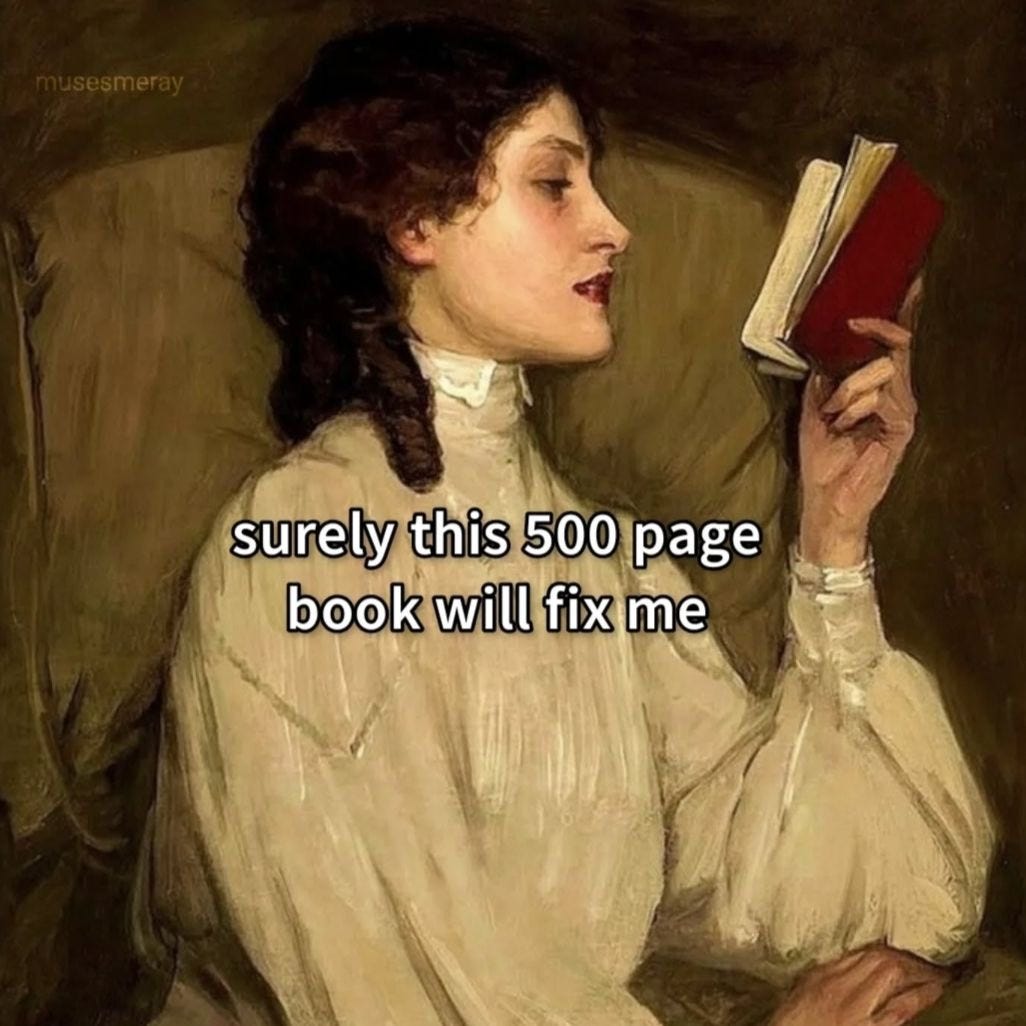
Then the book arrives. We read it. Maybe even underline passages. Maybe we feel something shift in chapter four. Maybe we think ‘Yes! This is it. I’m getting somewhere.’ And then nothing.
Or worse than nothing — confusion, frustration and the creeping realisation that this book, despite its 4.8-star rating on Goodreads and its spot on the New York Times bestseller list, has absolutely nothing to do with our actual situation. That the author’s version of closure still involved a #sponsored yoga retreat, a supportive ‘chosen’ family and an insanely expensive celebrity therapist they saw twice a week for three years and, of course, a book deal that reframed their trauma into a marketable narrative.
None of which applies to us.
We have no yoga retreat. But we do have an old apartment with a terrible old neighbour who bangs on the adjoining wall any time the tiniest sound is made. There’s no therapy twice a week because, well, the cost of living crisis. And our closure isn’t a publishable redemption arc that ends with valuable lessons learned and being grateful for the growth.
Closure is messier than that. It’s less poetic. Less sellable, engaging and viral.

The podcasts that promised everything and delivered nothing.
Sure, we’ve all got voices in our heads that tell us things for better or worse every day. But we also choose to have other voices in our ears — headphones on, world off, naively hopeful.
On Purpose with Jay Shetty. We Can Do Hard Things. The Happiness Lab. Every week, someone with a soothing voice and a compelling backstory sits down to tell us how they healed, how they found closure, how they moved on from their darkest chapter. They’re interviewed on other podcasts. They go on book tours. They post quotes from their episodes on Instagram. Neat little squares with sans-serif fonts that make complex emotional work sound like a simple five-step process that will always result in their definition of success.
‘Closure is giving yourself what you needed from someone else.’
‘Healing isn’t linear, but it is possible.’
‘You can’t move forward while looking backwards.’
We screenshot it. We save it. We send it to our group chat with three fire emojis and a love heart. We feel seen, heard, understood via the gram and the grid.
We listen to the full episode. Maybe we binge the whole back catalogue. We take notes. We feel inspired. We feel like maybe, just maybe, we’re on the path now. We’re doing the work. We’re engaging with the process. Then we’re at the shops trying to decide between splurging on the expensive olive oil or just going with the usual cheap one, and suddenly we’re crying again because we remember that dinner we cooked together and how they always bought the expensive one even though you said it didn’t matter and…
Wait. Wasn’t the podcast supposed to help with this? Why am I feeling all this when I am following the process?

The problem isn’t the podcast. The problem is that podcasts sell us other people’s closure. Other people’s frameworks. Other people’s timelines and breakthroughs and ‘aha’ moments. And those might be real for them. But they’re not ours.
So the host found peace through radical acceptance and boundary-setting and learning to ‘hold space for her inner child.’ Cool. But what if our inner child is a total jerk? What if radical acceptance sounds great in theory but feels like giving up? What if the boundaries set need conversations we’re not ready to have?
The podcast can’t answer that. Because the podcast doesn’t know us. But it sold us the idea that it could. When it doesn’t deliver, when we’re still stuck and confused and no closer to closure than we were before listening to 47 episodes, we blame ourselves.
We clearly didn’t listen hard enough. We obviously didn’t implement the strategies correctly. We mustn’t have done the journaling prompts with enough intention. We must be the problem. It’s our fault. We aren’t trying hard enough. We must be broken. We didn’t burn the letter and sage our space correctly. Our intentions weren’t meaningful enough. We should have used the fancy pink Himalayan salt instead of the supermarket brand because it was on sale.
We’re not the problem. The industrialisation of healing is the problem.
Boxing Day $ale! Every feeling must go!
In a world where everything is sold to us, and failure is not an option, we need to remember that closure can’t ever be a 10-step program. It’s not something we can manifest with the right morning routine and a Pinterest board. And it sure as hell doesn’t care that we’ve got two weeks off work and we really wanted to get it all sorted before the new year arrives.
All because we really wanted to post an aesthetic Instagram carousel about growth and transformation. The carousel needs to stay in draft, folks. Our hearts are not on a deadline. They never will be.
Oh hey. You’ve reached the part one pitstop.
Thanks for reading. Part 2 arrives on 1 January and ponders what happens when your brain says ‘let’s schedule closure for Tuesday between 12pm and 2pm’ and your heart says ‘lol, no’, why December is not your micro-managerial boss, and finding the permission you’ve been waiting for to be a mess on your own timeline.
Go gently over the next few days. See you on 1 January.